Vape coil, what the word really means
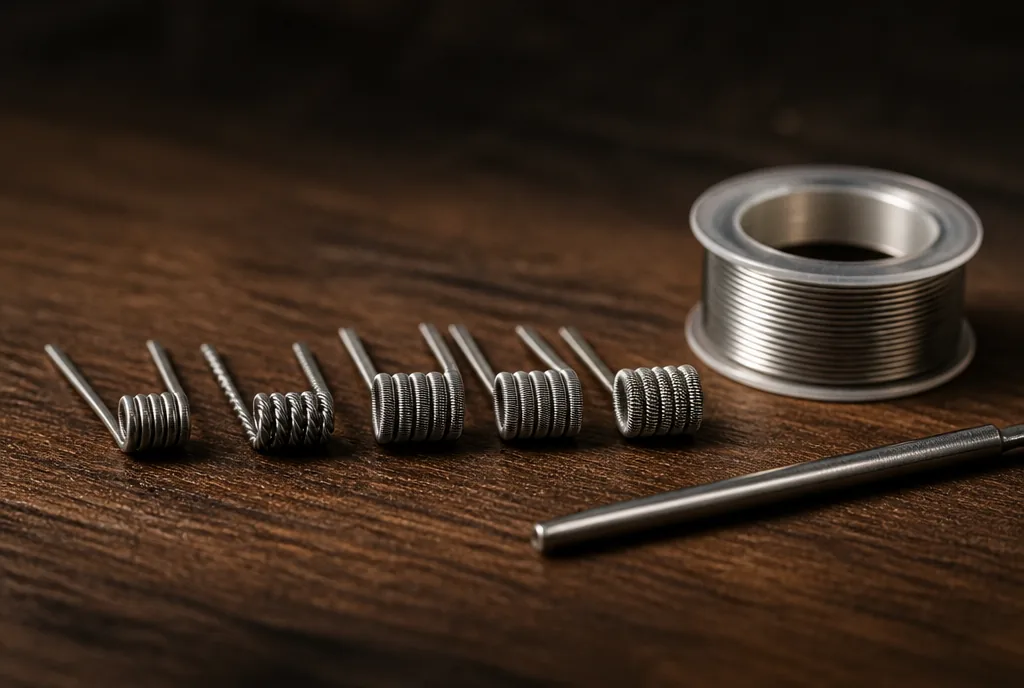
Search for a vape coil in a British shop and the results are almost all small metal heads, ready to screw into a tank. Open a rebuilder’s toolbox and the same word names a bare spiral of wire, often sold ten to a box. Two objects share one word, and neither fits where the other goes. This glossary entry pins down the strict meaning, maps the common one and decodes the vocabulary printed on coil listings.
Vape coil, the one-sentence definition
A vape coil is a length of resistance wire wound into a spiral, which heats when current from the battery passes through it and vaporises the e-liquid drawn up by the wick. In the strict sense the word names that bare wire, sold without cotton and meant for a rebuildable atomiser.
In ordinary British usage it mostly names something else, the replacement coil head that combines wire, wick and a metal housing in one replaceable part. Both meanings are current, and only the context of a listing settles which one is meant.
Coil, coil head and prebuilt coil, sorting the words
Four terms circulate for two objects. The table sets out the split that most listings follow.
| Term | What it names | Where it is used |
|---|---|---|
| Coil, strict sense | Wound resistance wire, sold bare, no cotton | Rebuildable atomisers (RDA, RTA, RDTA) |
| Prebuilt coil | A coil wound in advance, ready to fit | Boxes of coils for rebuildables |
| Coil head | Ready-to-use head, wire and cotton sealed in a housing | Tanks and some pods |
| Replacement coil | Shop name for a coil head | British shop categories |
The trap lies in British retail usage. The coils category of a typical UK vape shop lists coil heads almost exclusively, from mouth-to-lung to direct-to-lung models. A vape coil bought from that shelf is a head for one specific tank, not a spiral of wire to mount yourself.
Where the word coil comes from
In English, coil simply means a winding of wire, the same word an electrician uses for an electrical coil, and vaping took it over unchanged. The sense goes back to the first atomiser heads, which amounted to a strand of Kanthal wound into a small spiral, and it has outlived the mesh strips that many coil heads now use instead.
Reading a vape coil listing
A coil listing comes down to four notions, most of which appear in shop filters or in the product name. Knowing them is enough to compare two listings without mixing up their uses.
Wire gauge
Wire thickness is given in millimetres or in AWG, the American Wire Gauge scale, in which the number rises as the wire gets thinner. Worked out from the formula of that standard, 24 AWG equals 0.51 mm, 26 AWG equals 0.40 mm and 28 AWG equals 0.32 mm.
Inner diameter
The inner diameter is that of the rod the wire was wound around. Prebuilt coils are sold mostly at 2.5 mm and 3 mm, less often at 3.5 mm, and the figure has to suit the space available on the atomiser deck.
Wraps
Each turn of wire is called a wrap. The more wraps a coil has, the longer the wire and the higher its resistance in ohms, for the same wire and the same diameter.
Resistance in ohms
The figure on the box, 0.5 ohm for instance, is the electrical resistance the maker aimed for. It follows from the three points above and from the metal, whose effect is worked out further down.
Coil types, from round wire to framed staple
Listings sort coils into two families, depending on whether the wire stays single or combines several strands. The second family, known as exotic or complex coils, is often sold prebuilt.
Simple coils
The round coil, a single wound wire, remains the basic build. A twisted coil winds two wires together before coiling them, which leaves gaps where liquid can sit. Mesh replaces the spiral with a strip of metal grid, offered in Kanthal or Ni80.
Complex coils
A Clapton wraps a core of round wire in a very fine wire wound tightly around it. It takes slightly longer to heat than a single round wire. A fused Clapton sets two or more cores side by side under the same outer wrap.
An Alien goes further, with an outer wire stretched then rewound around several cores, which gives it a wavy look. A staple coil stacks flat ribbons of wire under the wrap, and a framed staple flanks those ribbons with two round cores.
Coil wires, from Kanthal to titanium
Five metals turn up on listings. The choice affects more than flavour, since it decides which output mode the mod can apply.
| Wire | Composition | Use stated on listings |
|---|---|---|
| Kanthal A1 | Iron, chromium and aluminium alloy | Wattage mode |
| Nichrome Ni80 | 80 per cent nickel, 20 per cent chromium | Wattage mode |
| Stainless steel 316L | Stainless steel | Wattage and temperature control |
| Nickel Ni200 | 99 per cent pure nickel | Temperature control only |
| Titanium | Titanium | Temperature control only |
Temperature control tracks the rise in resistance of the wire as it heats, and nickel Ni200 is the wire whose resistance changes most with temperature. Kanthal A1, by contrast, keeps a resistivity factor of 1.00 between 100 and 400 °C according to its manufacturer’s datasheet, so the chipset has no variation to read.
The same datasheet gives a resistivity of 1.45 Ω·mm²/m for Kanthal A1, against 1.09 for the maker’s 80/20 nichrome. On a 0.40 mm wire that works out at roughly 11.5 ohms per metre in Kanthal and 8.7 in Ni80. For the same geometry, an Ni80 coil therefore reads about a quarter lower.
Where the word shows up on a screen
On a regulated mod, the coil shows itself first through its resistance, displayed as soon as an atomiser is screwed on. The word itself mostly appears in error messages, which are written in English.
The message no coil detected reports that the circuit finds no measurable resistance. The coil may be missing or loose on its posts, the typical case of an RDA put back together after cleaning.
What the word does not tell you
The phrase vape coil says nothing about the wire, the resistance or the compatibility. Two products sold under that name may share only the spiral, one clamped onto a deck, the other screwed straight into a tank.
A coil head is chosen from the range made for its device, such as the GTX coils used by the Luxe XR Max 2. In the UK it also sits inside a tank or pod capped at 2 ml by the Tobacco and Related Products Regulations 2016, a limit that applies to the container rather than to the coil.
FAQ
These questions come up around coil listings and complete the entry without repeating it.
What is a prebuilt coil?
It is a coil already wound to shape, sold boxed and ready to fit on the deck. It skips the spool and the winding jig, which matters most for complex builds that take a long time by hand.
Can a coil be cleaned?
A bare coil can be fired dry, without cotton, to burn off residue before taking a fresh wick. This step, known as a dry burn, has no equivalent on a coil head, whose cotton stays sealed inside the housing. Titanium is the exception and is never fired dry.
Does a coil wear out?
Yes, though more slowly than a coil head, since only the cotton is changed at each clean. Falling vapour production, dull flavour, or a metallic or burnt taste signal a wire that needs cleaning or replacing.
What do MTL and DL mean on a box of coils?
They state the draw the coil was designed for, MTL for mouth-to-lung and DL for direct-to-lung. The resistance remains the figure to check, because two coils marked MTL can carry very different values.
What is a coil wound around?
Around a jig, a set of calibrated rods on which the wire is wound turn by turn. The rod diameter sets the inner diameter of the coil, which is essential for reaching the target resistance.
Vape coil, the meaning worth keeping
Strictly speaking, a coil is wound resistance wire, sold bare for rebuildables, while ordinary British usage applies the word to the coil head. A listing reads through four notions (gauge, inner diameter, wraps and resistance), and the metal decides which output mode is possible.
Vaping hardware vocabulary makes more sense piece by piece, from the cell to the deck. Faced with an ambiguous listing, the first question stays the same, whether the vape coil on offer is bare wire or a head to screw in.
Editorial content for adult readers only. Vaping products can contain nicotine, a substance that causes addiction. Nicotine vaping products are not for sale to anyone under 18 in the UK. This article is not a buying recommendation.
 01
01  03
03