Vape battery charger: what the term means
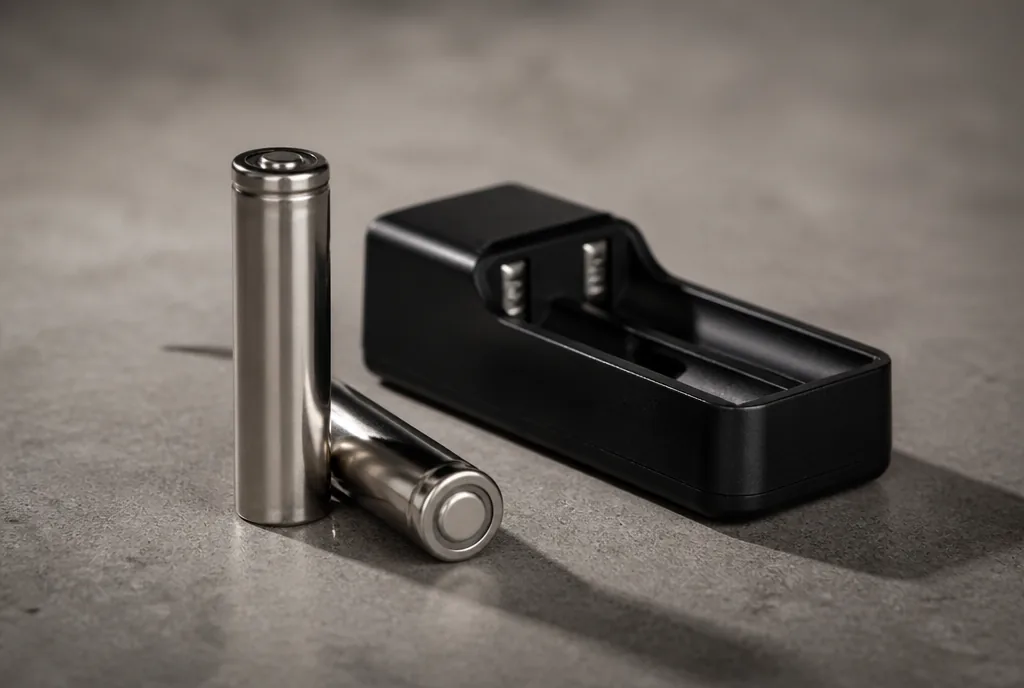
Ask two vapers what the phrase means and you get two different objects. One pictures the external unit with several bays sitting on a shelf, the other pictures the USB-C cable that came in the kit box. That ambiguity sends a fair number of orders wide of the actual need, and product listings do little to help, stacking acronyms and current ratings without saying what they govern. This glossary entry takes a vape battery charger apart term by term.
What a vape battery charger is
A vape battery charger is an external unit that recharges one or more lithium-ion cells taken out of the mod, controlling the voltage and current applied at each bay independently. It stands apart from onboard charging, where the cell stays inside the device and the mod chipset runs the operation over its own USB-C port.
That distinction is the heart of the term. Without it half the conversations on the subject go nowhere, because the two speakers are describing different hardware and different behaviour.
External charging or onboard charging
Both methods coexist on British shelves and they do not serve the same purpose. The choice depends less on budget than on the sort of kit in daily use, and it is not an exclusive one, since plenty of vapers do both depending on the week.
Onboard charging means plugging in the device itself and letting the built-in electronics apply the charge profile. It is the only option on a pod with a sealed battery, where the cell simply is not extractable, as on the Vaporesso Luxe XR Max 2 and its built-in pack.
On a mod with removable cells the same method works but treats the pair as a single unit. A twin bay mod charges its two cells in series through one port, with no way of correcting an imbalance that has crept in between them.
External charging means pulling the cells out and dropping them into the bays of the unit. Each bay carries its own regulation, so each cell is handled on its own terms, which is the only way to spot the one that climbs faster than its twin and to catch a matched pair going out of match.
Reading the specification of a vape battery charger
These units are described with a small vocabulary, five or six words that recur across every brand stocked in Britain. Knowing them lets you compare two models in seconds rather than minutes.
Bays are the charging slots. British retailers list one, two and four bay units as standard, with eight bay models available for people running a large stock of cells. Anyone using a twin battery mod is covered by a two bay unit.
Charge current, quoted in amps, sets the speed. Entry level models apply a fixed value, often 0.5 A or 1 A. More complete units let you choose, typically between 0.5 A and 2 A per bay, and the point of that adjustment is simple: every cell carries a maximum charge current on its datasheet, and a vape battery charger has to allow you to respect it. A fixed current unit does not always do so.
Automatic detection means the unit identifies the chemistry and voltage of whatever is inserted and applies the matching profile. It exists precisely to avoid pushing a lithium-ion profile into a cell that is not one.
A display shows measured voltage, applied current and sometimes the capacity put back into the cell in milliamp hours. That last figure is genuinely useful, because tracking it month after month is how you watch a cell age.
Extra modes cover controlled discharge, capacity testing and the recovery of a deeply discharged cell. Those belong to diagnosis rather than to everyday routine, and most people never touch them.
The 4.2 volt cut-off
Here is the technical marker that explains almost everything these units do. A lithium-ion cell is charged to a standardised end of charge voltage of 4.2 V, with a tolerance of a few hundredths of a volt either side.
The cycle runs in two stages. The unit first applies a constant current until that voltage is reached, then holds the voltage steady and lets the current fall away to a low threshold that marks the end of charge.
That second stage, slow and invisible on most displays, is why the last portion of a charge takes proportionally far longer than the first. A unit that simply stops the moment 4.2 V appears hands back a cell that is not actually full.
The brands on British shelves
Four names recur across UK vape retailers: Nitecore, Xtar, Efest and Vapcell, with Gyrfalcon appearing regularly alongside them. Between them they cover the whole spread, from a plain two bay fixed current unit up to a four bay analyser with a detailed screen.
The most useful sorting criterion remains format compatibility. A unit designed around shorter cells will not always seat a 21700 battery and its 70 mm of length, so the accepted length range is worth reading before anything else.
The second criterion is adjustable current. It sits a little higher up the range and it is what makes respecting the cell datasheet possible at all, which is the whole reason for owning the thing.
What the unit does not do
A clarification is needed here, because commercial language around these products sustains several misunderstandings. An external unit runs an electrical operation. It repairs nothing and it reverses no wear.
It does not rebalance a mismatched pair of cells. It lets you see the gap, by displaying the capacity returned to each one, but replacement remains the only answer to a gap that has settled in.
It does not extend the life of a cell beyond what its chemistry allows. Respecting the charge current stated by the manufacturer simply avoids shortening that life unnecessarily.
Nor does it replace inspection. A vape battery charger reports an electrical fault through an error message, never a nicked wrap or a deformed terminal, and those are found by looking rather than by measuring.
Frequently asked questions
Can cells be left in the unit once charging has finished?
Regulated models cut the current at the end of the cycle and do not trickle charge. Taking the cells out anyway remains the common habit among regular users.
Does a universal unit suit every cell?
No. Each model states a range of diameters and lengths plus a list of compatible chemistries. A cell outside that range either fails to make contact or receives an unsuitable profile.
What does CC CV on the display mean?
It names the two phases of the cycle: constant current, then constant voltage. That is the standard description of a lithium-ion charge profile.
Should a new cell be charged before first use?
Cells leave the factory partially charged, at roughly half capacity. A full charge before the first session is ordinary practice.
Is an eight bay unit worth it for home use?
Rarely. That format is aimed at people cycling a large stock of cells. Two or four bays cover domestic use comfortably.
Getting the word right before getting the kit right
A vape battery charger is an external unit that recharges cells one by one, distinct from the onboard charging a mod runs over its own port. Bay count, adjustable current and the range of accepted formats summarise nearly everything on its specification sheet.
The term belongs to the electrical family of vaping vocabulary, sitting beside the words that describe the cells themselves and the builds that lean on them hardest. The rest of that family is gathered in the technical terms section of this glossary, and reading it as a set is what stops a vape battery charger listing from looking like a wall of unexplained numbers.
Editorial content for adult readers only. Vaping products usually contain nicotine, a substance that causes addiction. Not for sale to under-18s in the United Kingdom. This article is not a buying recommendation.
 02
02  03
03