21700 battery: what the five digits mean
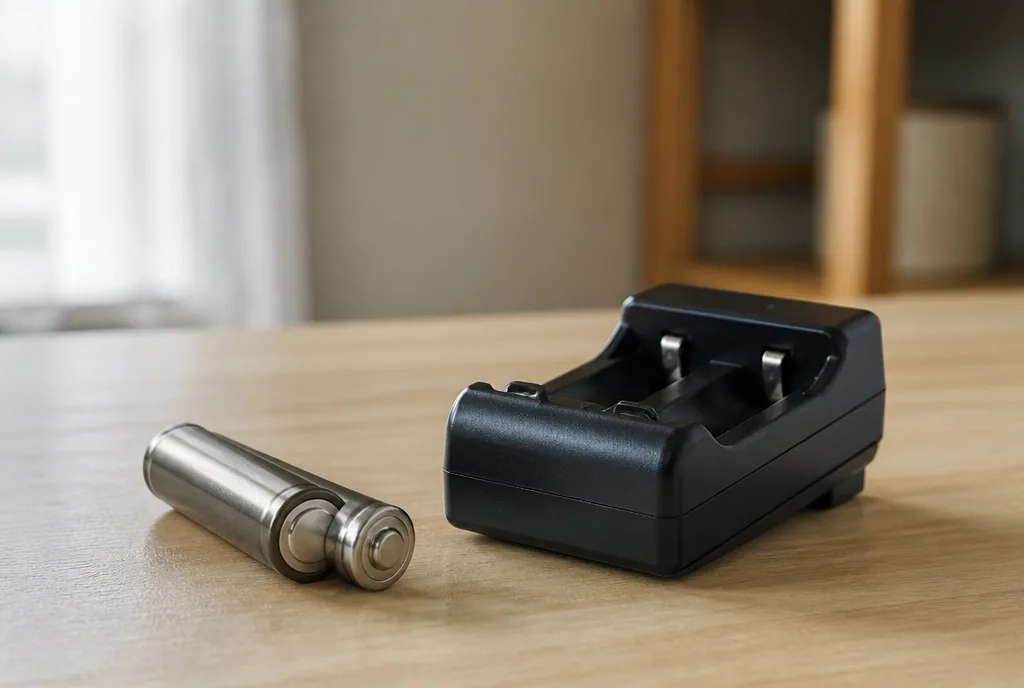
Five digits printed on a coloured wrap, a capacity in milliamp hours, a current in amps. A cell listing reads like a laboratory sheet, and British retailers quote figures that vary by a factor of two for what is nominally the same format. None of that vocabulary is arbitrary. A 21700 battery is named according to a normalised convention, and every number on the wrap describes a measurable property. This entry unpacks each term in turn.
What a 21700 battery is
A 21700 battery is a cylindrical rechargeable lithium-ion cell measuring 21 mm in diameter and 70 mm in length. The first two digits give the diameter, the next two the length, and the final zero records that the cell is cylindrical in shape.
That five digit convention covers every cylindrical lithium-ion cell, which is why the neighbouring format is called the 18650. It measures 18 mm across and 65 mm long, and it dominated British mod shelves for the best part of a decade before the larger size arrived.
Battery, cell or accumulator: the words UK shops actually use
British listings almost always say battery, and occasionally cell. The word accumulator, standard in French technical writing, barely appears on UK sites at all, so there is no point looking for it on a product page here.
Vaping vocabulary in Britain has settled on a workable shorthand. Battery covers both the removable cylindrical item you slot into a mod and the sealed pack soldered inside a closed device, and the context does the disambiguating work.
Where precision matters, cell is the safer word. A cell is one electrochemical unit, whereas a battery strictly means an assembly of several. A dual battery mod therefore holds two cells, and a built-in battery device such as the Vaporesso Luxe XR Max 2 and its 3200 mAh pack holds one that you cannot remove.
The figures printed on a 21700 battery wrap
Four indications appear on nearly every cell sold in a British vape shop. They are not read independently of one another, and it is their combination that decides whether a given cell suits a given build.
Nominal voltage is quoted as 3.7 V on lithium-ion chemistry. That value is a working average rather than a fixed output: the cell leaves the charger at roughly 4.2 V and runs down to a low cut-off usually set around 2.5 V by the mod. A 21700 battery therefore never delivers a constant voltage, and a regulated chipset compensates for that slope to hold the requested wattage while charge remains.
Capacity is expressed in milliamp hours and describes how much charge the cell stores. UK stockists list genuinely available 21700 cells mostly between 3000 and 5000 mAh, and figures well above that range deserve to be checked against the cell manufacturer documentation rather than the reseller listing.
Continuous discharge current, written in amps, states the current the cell can supply without undue strain. It is quoted alongside a much higher pulse figure claimed for very short bursts, and the continuous value is the one that matters in daily use. A low resistance build draws a high current, so the choice of cell should start from that demand rather than from headline capacity.
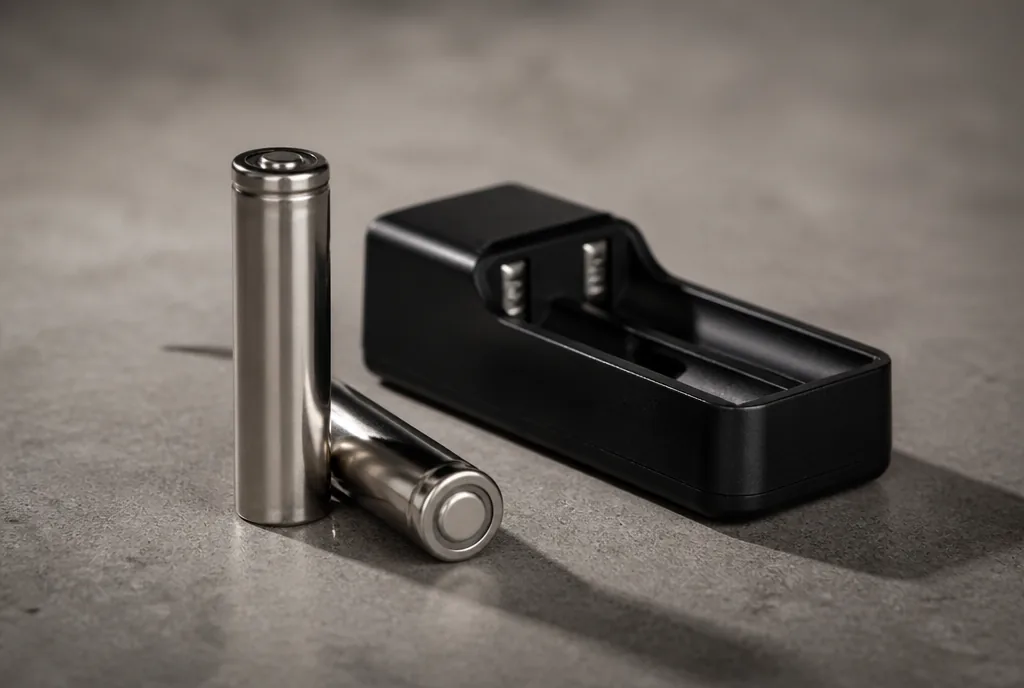
The positive terminal comes in two shapes. A flat top presents a flush pole, a button top a small raised nub. Certain mods and certain contact clips accept only one of the two, and the difference is a couple of millimetres of overall length.
What the 21700 changes compared with an 18650
Moving from one format to the other is not simply a question of bulk. The two sizes answer different trade-offs, and recent British kits increasingly settle in favour of the larger one.
The extra internal volume of the 21700 allows, at comparable chemistry, a higher capacity and a more comfortable discharge headroom. The mod gains runtime and safety margin, and gives up some compactness in the hand and pocket.
Many mods built around the larger size will also take an 18650 with a supplied cylindrical adapter sleeve. The reverse is never true, since the extra three millimetres of diameter will not enter a tube machined for 18 mm.
The wrap is not a decoration
Here is the point buying guides rarely make. The coloured heat shrink sleeve around the cell is the only insulator between the metal body and the positive terminal, and it is doing a real job.
On a cylindrical cell the entire casing sits at negative potential, including the ring that surrounds the positive pole at the top. A nicked wrap therefore puts two opposing polarities in direct contact the moment the cell touches a metal surface.
A damaged wrap means rewrapping the cell before any further use, or retiring it. Replacement sleeves in the correct diameter are stocked by most British specialists and take under a minute to fit with a hot air source.
Carrying and disposal in the UK
Bare cells travel in a rigid case that prevents any contact between the terminals and a metal object. A key or a coin loose in the same pocket is enough to bridge the two polarities across the top of a 21700 battery.
At end of life the cell falls under waste electrical and electronic equipment rules. Vape shops and household recycling centres in Britain operate collection points for lithium cells, which have no business in a general waste bin or a kerbside recycling box.
Where the real specifications live
One quirk of this market deserves stating plainly. Cells sold in vape shops are overwhelmingly produced by a small handful of manufacturers and then rewrapped under a distributor brand.
The wrap therefore carries the reseller name rather than the producer name, and the printed values belong to marketing rather than to the original datasheet. That is how two shops can advertise very different numbers for what is physically the same item.
The reference documentation remains the cell manufacturer datasheet, published against a precise model reference. When that reference is not disclosed, the figures on the wrap cannot be verified, and the absence is itself a piece of information. Cells that state their original reference allow a documented purchase, and demanding it costs nothing.
Frequently asked questions
How many charge cycles does a cell of this size last?
Manufacturers generally quote several hundred cycles. The exact figure sits on the cell datasheet and varies a great deal with how hard the cell is worked.
Can two cells of different ages share a dual battery mod?
No. A twin bay mod needs two cells of the same model, the same age and the same state of charge, otherwise the pair drifts out of balance.
What does INR mean on a wrap?
It describes the internal chemistry. I stands for lithium-ion, N for a nickel manganese cobalt cathode, R for the cylindrical form. ICR and IMR denote other chemistries.
Can these cells be charged inside the mod?
Many mods offer internal charging over USB-C. It serves at a pinch, but it does not replace a dedicated unit that watches each cell individually.
Why are some cells sold as matched pairs?
Because twin bay mods work in series or in parallel. Cells from the same production batch have closely comparable characteristics, which limits imbalance in use.
The three numbers worth remembering
A 21700 battery comes down to three pieces of information: its dimensions, given by the name itself, its capacity in milliamp hours and its continuous discharge current in amps. Chemistry, brand and wrap colour follow after those.
This entry touches several neighbouring words in the glossary, particularly the ones describing how cells are recharged and the builds that demand the most from them. The external vape battery charger entry covers the first, and the RDA entry the second, since a rebuildable deck is the classic reason for reaching for a high drain cell in the first place. The electrical vocabulary of vaping reads as a set rather than one word at a time.
Editorial content for adult readers only. Vaping products usually contain nicotine, a substance that causes addiction. Not for sale to under-18s in the United Kingdom. This article is not a buying recommendation.
 02
02  03
03